












Cashew Container Stuck in Italy: The 2026 Case and Lessons From 100 Containers in 2022
Updated: 05/10/2026 · 5 min read · Aguero Tran, Sales Executive
In short: a container of Vietnamese cashew kernels is stuck in an Italian port because the original shipping documents reached the end buyer when the buyer had paid only a deposit. The Vietnam Trade Office in Italy warns that more shipments may follow the same pattern, and points back to the 100-container case of 2022. This article compiles the facts from the parties involved.
The 2026 case: one container, three parties
The parties. A Vietnamese exporter sold the shipment to a trading company in Dubai, which resold it to an importer in Italy.
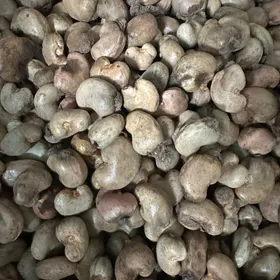
The goods. One container of cashew kernels arrived at La Spezia/Livorno in August 2026.
The money. The Dubai trader had paid the Vietnamese exporter USD 100,000. The Italian company had paid a deposit of about EUR 40,000.
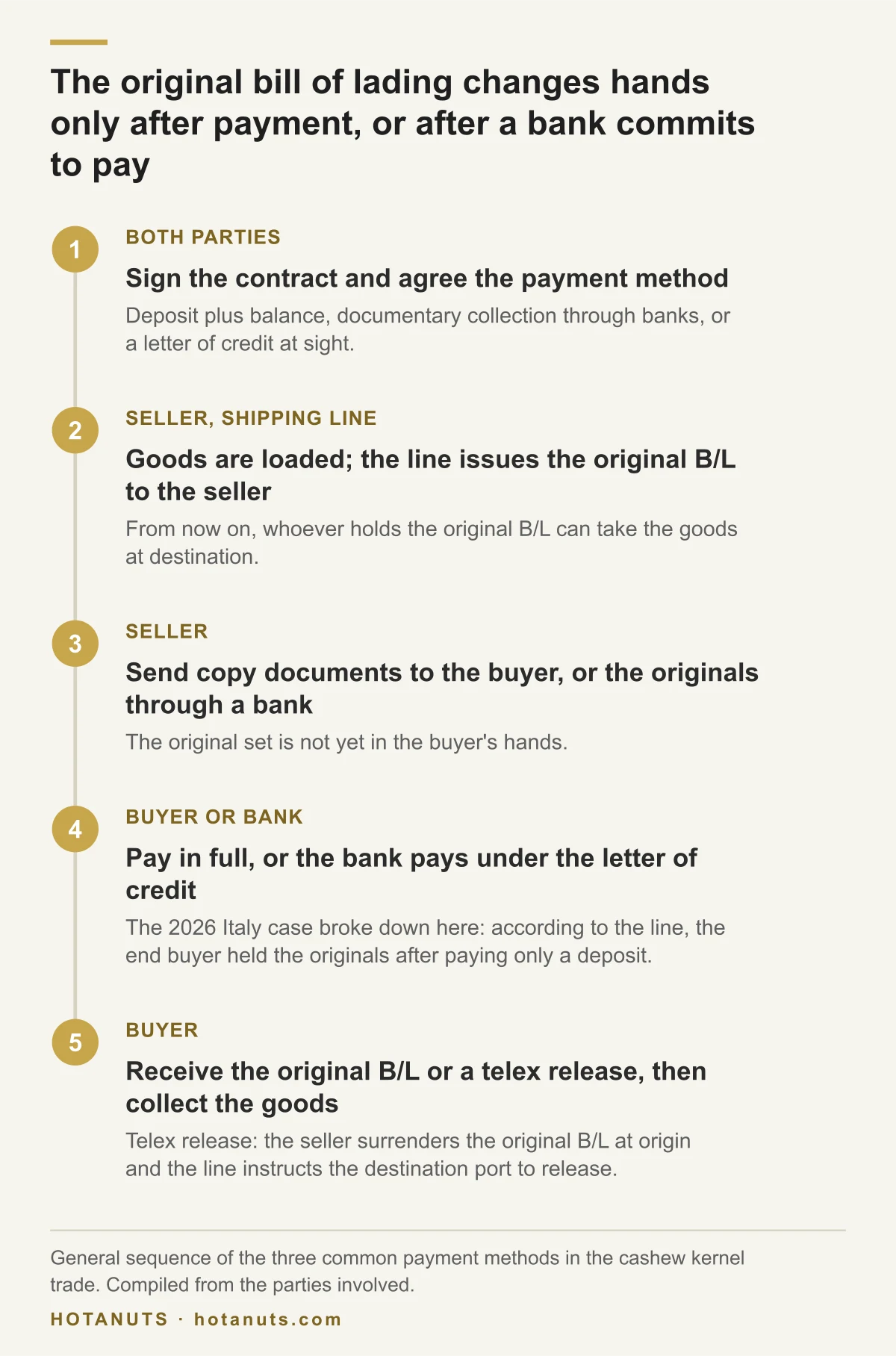
The documents. From here the original documents and the money went separate ways. The courier reported that the documents had been delivered against signature. The bank in Italy said it was not holding them and that the Italian company was not its client. The shipping line reported that the buyer held the original documents and was pressing for release of the cargo.
Verification. The Trade Office confirmed that the Italian company is a real business and was itself the party to the deal, not an impostor. Its declared revenue, however, was unusually high for its registered size.
How the case is being handled
- Holding the cargo. Because the exporter raised the alarm early, the Trade Office worked with the shipping line to keep control of the container so it would not be released to a party without the right to it.
- Lawyers. The Trade Office connected the Vietnamese and Dubai sides with an Italian law firm that handled the 2022 case. The firm warned the Italian side that legal action in Italy was possible.
- Negotiation. The Italian side's lawyer offered to return the original documents if the full deposit of about EUR 40,000 was refunded. The Dubai trader refused and offered EUR 20,000, after deducting storage, legal fees and the cost of moving the goods to a new buyer.
- Status. When the warning was issued, the parties were still negotiating. The Trade Office continues to follow the case and will report to Vietnam's Ministry of Industry and Trade.
The warning: possibly 25–35 more containers
According to the lawyer and the two companies involved, sources in the cashew trade say about 25–35 more containers from Vietnam may have shipped, or be shipping, to Italy on similar terms. The Trade Office says this is not yet fully verified, but issued an early warning because the case resembles 2022 in many ways.
Exporters are asked to review all cashew sales to Italy since late July 2026 and to watch for seven signs:
- A new partner with no clear trading history.
- Legal details that are inconsistent or unusual.
- Irregular registration number, tax code, address or legal representative.
- A partner asking for, or trying to control, the original B/L before paying in full.
- Late or missed payments, or a sudden request to change the payment method.
- Unusual behaviour around taking delivery once the goods arrive.
- Any sign that the exporter may lose control of the goods or the original documents.
For shipments already in an Italian port but not yet released, exporters should contact the shipping line or its agent at once. If more similar cases surface, the Trade Office, the Vietnam Cashew Association and Italian lawyers will compile the evidence for the Italian authorities, including the Guardia di Finanza.
The 2022 precedent: how 100 containers were recovered
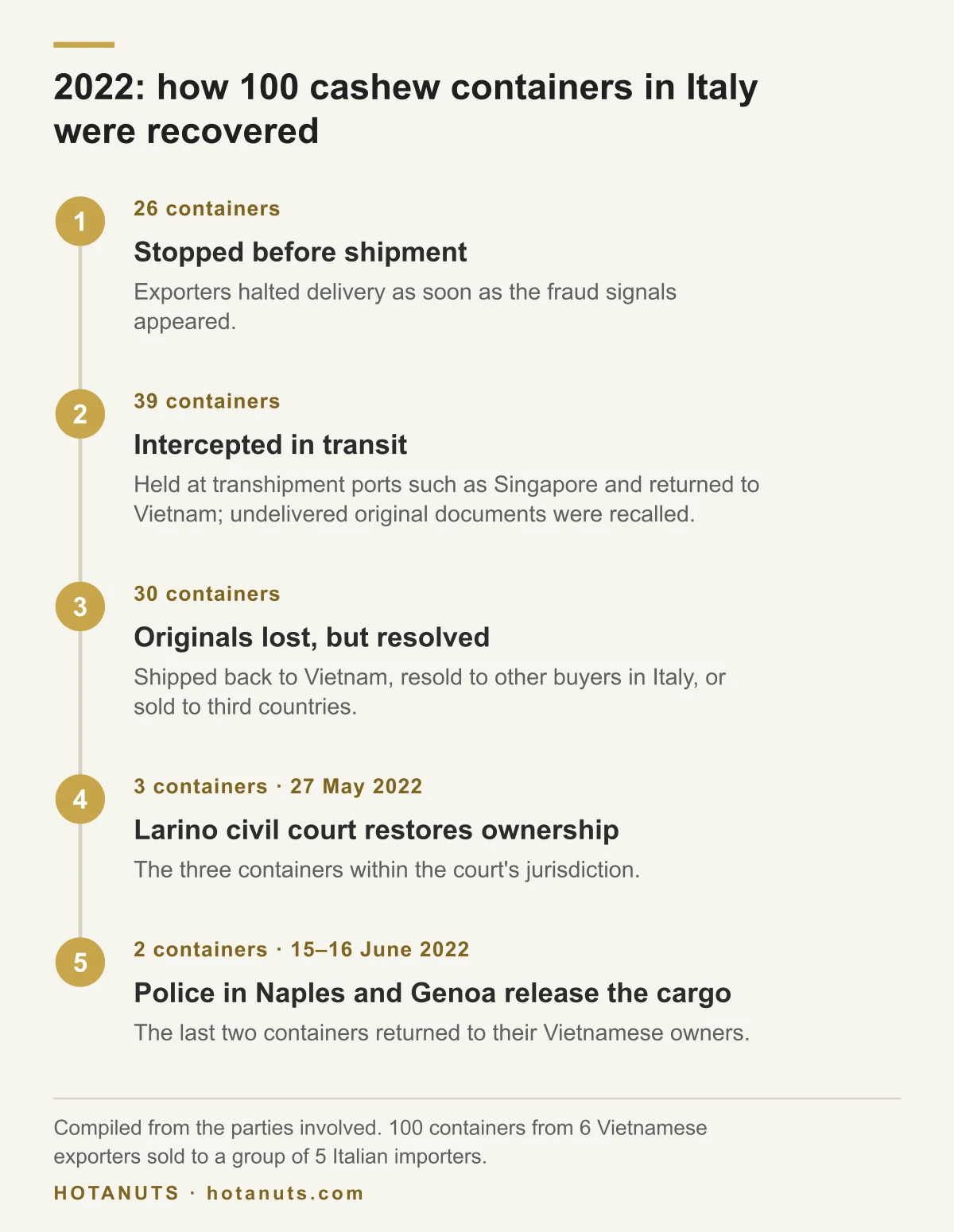
In early March 2022, the Vietnam Cashew Association alerted the Ministry of Industry and Trade that a group of Vietnamese exporters had sold cashews to Italy, had not been paid, and showed signs of fraud. The case covered 100 containers from 6 Vietnamese exporters, sold to a group of 5 Italian importers.
The Ministry set up a task force and the Trade Office investigated. On 20 April 2022, Vietnam's Prime Minister raised the case directly with Italy's Prime Minister. The outcome by mid-June 2022:
| Group | Containers | Outcome |
|---|---|---|
| Not yet shipped | 26 | Delivery stopped as soon as fraud signs appeared |
| Shipped, intercepted | 39 | Held at transhipment ports such as Singapore and returned to Vietnam; undelivered originals recalled |
| Original documents lost | 30 | Returned to Vietnam, resold to other buyers in Italy, or sold to third countries |
| Still in Italian ports | 3 | Ownership restored by the Larino civil court on 27 May 2022 |
| Still in Italian ports | 2 | Released by the Naples financial police and the Genoa port military police on 15–16 June 2022 |
| Total | 100 | All ownership returned to the Vietnamese exporters |
The result came from many agencies working together: Vietnam's ministries of industry and trade, foreign affairs and public security, the Trade Office, both countries' embassies, and Italian courts and police.
What the two cases have in common
Both cases turn on one point: at the destination port, the shipping line releases cargo to whoever presents the original bill of lading, not to whoever has paid. Once the originals reach the buyer before full payment, the exporter has to recover the goods through negotiation or the courts, even when the counterparty is a real company.
The 2022 lesson is just as clear: the containers recovered most easily were those stopped early, before the original documents left the exporter's hands. Those whose originals were lost took months and needed authorities in both countries.
For buyers
- Buying direct from an exporter: choose terms under which the original B/L follows the money: deposit plus balance against copy documents, documentary collection, or a letter of credit at sight for a first order. State the chosen terms in your first request for quotation.
- Buying through a trader: before paying a deposit, ask who is named as seller on the contract and the bill of lading, whose account receives your money, and which bank handles the original documents. If nobody answers clearly, stop.
Send us the draft payment terms for your first order and we will show you at which step the original B/L changes hands. Our earlier article on four fraud patterns in trade with Italy covers other warning signs.
Compiled from information provided by the authorities, associations and companies involved; updated 05/10/2026. Not legal advice. Company names in the case are omitted.