




Cashew Grade Guide: What W180, W240, W320 and BB Actually Mean
Last updated: 2026-09-22 · 14 min read · By Tùng Trần, Sales Executive
Key takeaways
- Cashew grades are counts, not quality tiers: W240 means 220–240 kernels per pound
- W and WW prefixes are interchangeable notation for the same white whole grades
- Blemished and spotted grades — DW, SL, SK — cost 10–25% less for identical size and crunch
- Ten of seventeen audited supplier sites list grade codes; only two cite AFI, the standard defining them
- Grade choice is a product economics decision made before any price negotiation
Table of contents
- What does a cashew grade code actually measure?
- Why do some suppliers write W320 and others WW320?
- The full count table
- Premium whole kernels: W160 to W240
- Standard whole kernels: W320 to W500
- The grades nobody explains: DW, SL and SK
- Splits and pieces: WS, LP, SP, BB, SW
- What quality parameters come with a grade?
- What the grade code does not tell you
- Why can't I order only W180?
- Which grade should I choose for my product?
- When does grade substitution work?
What does a cashew grade code actually measure?
A cashew grade code measures kernel count per pound, not quality. W240 means 220 to 240 whole white kernels weigh one pound. A lower number means larger kernels and a higher price. Quality is defined separately, through moisture, broken and defect tolerances that the grade code says nothing about.
This is the single most common misunderstanding in cashew procurement, and it costs money in both directions. A buyer who believes W180 is "better quality" pays a premium for size they may not need. A buyer who believes W450 is "low quality" rejects a grade that would work perfectly inside a cookie.
The grading framework comes from the Association of Food Industries, whose cashew standard defines both the count bands and the defect tolerances used across international trade. In our September 2026 audit of 17 Vietnam supplier websites, ten listed AFI grade codes — and only two named AFI. The vocabulary has spread further than the standard.
Two kernels of identical quality can carry different grade codes purely because one tree produced bigger nuts. Size drives price because retail packaging sells on visual impression, not because a bigger kernel tastes better.
Why do some suppliers write W320 and others WW320?
They mean exactly the same thing. W stands for White, WW for White Whole. AFI documentation uses the W prefix; many Vietnamese exporters write WW. A quote for WW320 and a quote for W320 describe an identical specification, and the notation difference carries no commercial meaning.
Our audit found both notations in active use, sometimes on the same site. It is worth knowing simply so that a mixed set of quotes does not look like a mixed set of products. When you normalise supplier replies into a comparison sheet, collapse WW into W and the confusion disappears.
The same principle applies elsewhere in the vocabulary. Scorched grades appear as SW and SSW; blemished wholes carry the AFI code BW but trade in Vietnam as DW. None of these are different products — they are different naming habits attached to the same standard. Ask any supplier to restate their grade in AFI notation and the ambiguity resolves in one email.
The full count table
Whole white cashew grades run from W160 at 140–160 kernels per pound down to W500 at 450–500. Because most international contracts are written in metric tonnes while grades are defined per pound, it helps to hold both figures: W160 is roughly 309–353 kernels per kilogram.
| Grade | Kernels per lb | Approx. per kg | Position |
|---|---|---|---|
| W160 | 140–160 | 309–353 | Largest grade produced |
| W180 | 170–180 | 375–397 | Premium |
| W210 | 200–210 | 441–463 | Premium |
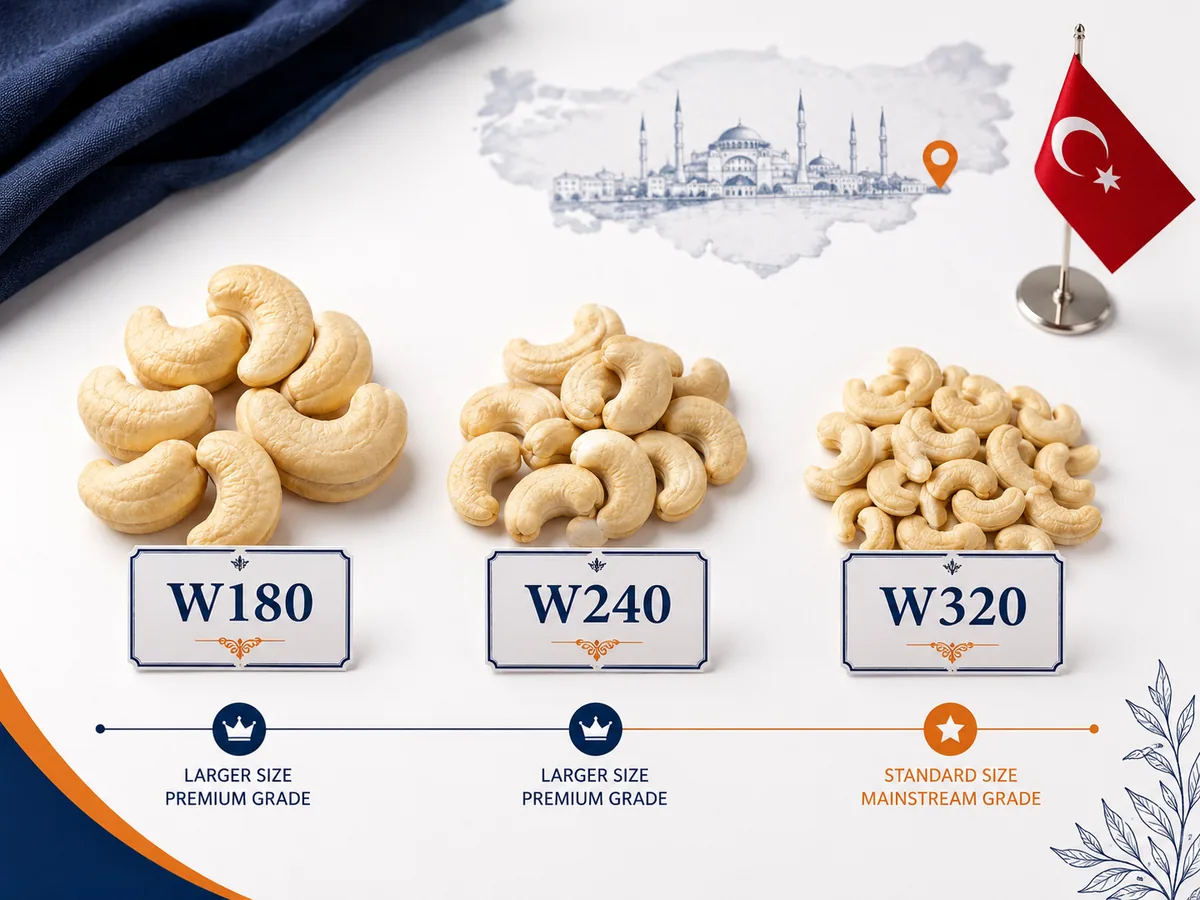
| W240 | 220–240 | 485–529 | Mainstream premium |
| W320 | 300–320 | 661–705 | Volume benchmark |
| W360 | 340–360 | 750–794 | Industrial |
| W450 | 400–450 | 882–992 | Bakery, confectionery |
| W500 | 450–500 | 992–1,102 | Trail mix, muesli |
One kernel of W160 weighs roughly 2.83–3.24 grams. That single figure explains most of the price ladder: you are buying fewer, heavier kernels, and the raw nut required to produce them is scarcer.
Premium whole kernels: W160 to W240
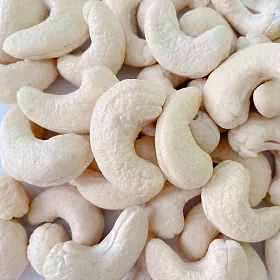
W160 through W240 are the large whole kernels that retail packaging is built around. These grades dominate gift packs, premium retail jars, and the Middle East, Chinese, Japanese and Korean markets where visible kernel size drives purchase decisions.
| Grade | Kernels per lb | Typical use | Strong regions |
|---|---|---|---|
| W160 | 140–160 | Premium gifting, festive boxes | UAE, Saudi, China, Japan, Korea |
| W180 | 170–180 | Gift packs, premium jars | Turkey, Israel, Gulf retail |
| W210 | 200–210 | Ethnic retail, festive packs | Lebanon, Middle East |
| W240 | 220–240 | Mainstream premium retail | EU, US, Japan |
W160 sits at the top and behaves like a scarce good rather than a commodity. Output is limited because each lot demands unusually large raw nuts plus selective processing, so availability moves with the crop in a way that W320 never does. If your product depends on W160, treat supply as the constraint and price as the consequence.
W240 is the workhorse of this group. It looks generous in a jar without carrying the price step that W180 demands, which is why it recurs across so many retail lines and why it functions as the reference point most buyers price other grades against.
The economics tighten quickly as you move up. Going from W240 to W180 is a meaningful cost increase for a size difference the shopper registers as "big cashews" either way. That step is worth paying for when the pack is transparent and the product is positioned as a gift; it is rarely worth paying for when the cashew is one ingredient among several.
Standard whole kernels: W320 to W500
W320 is the highest-volume cashew grade in international trade, with 300–320 kernels per pound. W360, W450 and W500 continue downward in size. These grades serve bulk retail, industrial snack production and bakery applications where kernel integrity matters but individual size does not drive the purchase.
W320 sits at the point where supply is deepest and pricing is most competitive. If your product needs whole kernels but does not sell on kernel size, W320 is the correct starting assumption, and the burden of proof sits with any argument to move up.
W450 and W500 reward a specific situation: applications where the cashew is dispersed through a matrix. In a cookie, a cereal cluster or a trail mix, a smaller whole kernel distributes more evenly, costs less, and no consumer measures it. Buyers often discover that a product they spec'd in W320 performs better in W450, because more kernels per pack means more cashew in every mouthful for less money.
W360 occupies a quieter position between the two, and shows up most often in industrial specifications where a processor has tuned a recipe to a particular kernel size.
The grades nobody explains: DW, SL and SK
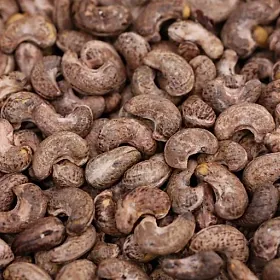
Blemished and spotted grades are whole kernels of normal size and crunch that carry colour variation or surface marks. They trade 10–25% below equivalent white grades. Most of the marking originates from pre-harvest pest attack on the kernel, not from processing failure — the eating quality is unaffected.
This is the least documented and most commercially useful corner of the cashew grade system. Our audit found essentially no supplier website that explains it, yet it is where the largest savings sit for the right application.
| Grade | What it is | Typical discount |
|---|---|---|
| LBW240 | White kernels, 220–240/lb, slight breakage, higher defect tolerance than WW240 | 12–18% below WW240 |
| SL | Light yellow to light brown, at least one light spot over 1 mm | 10–15% below premium WW |
| SK1 | Carries coloured spots over 1 mm — one grade darker than SL | Below SL |
| SK2 | Two or more coloured spots, or three light spots — one grade more spotted than SK1 | Below SK1 |
| DW320 (AFI: BW) | Blemished wholes, 300–320/lb, deep yellow to brown or amber | 15–22% below WW320 |
| DW360 (AFI: BW) | Blemished wholes, 340–360/lb | 18–25% below WW |
Two things are worth understanding precisely here.
The cause is agricultural, not industrial. Spotting on SL and SK grades comes from pests attacking the kernel while the nut is still on the tree. It is not a sign that a factory handled the lot badly, and it does not indicate contamination. Kernel shape and crunch stay intact.
The AFI code and the Vietnamese trade name differ. Blemished wholes are coded BW in AFI documentation and traded as DW on the Vietnamese market. A quote for DW320 and a quote for BW320 are the same product. This trips up buyers who search their contract standard for a code their supplier never uses.
The published tolerances for the DW class are specific: moisture max 5%, broken max 10%, lower size grade max 10%, total defects max 14%, with brown speckles or blemishes on no more than 60% of kernels. Colour may run deep yellow, brown, amber, or light to deep blue.
For coated chocolate, granola, cashew milk, cashew butter and seasoned snack lines, the colour is masked by other ingredients before the consumer ever sees it. Paying the white premium in those applications is paying for an appearance that gets covered up in the first processing step.
Splits and pieces: WS, LP, SP, BB, SW
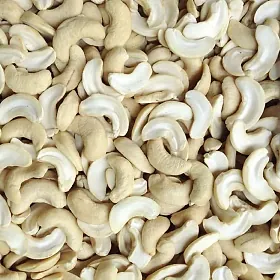
Broken grades are whole kernels that fractured during shelling — same nut, same quality parameters, lower price. WS is white splits, LP large pieces, SP small pieces, BB baby bits. SW is scorched wholes, discoloured by heat during processing but intact and food-safe.
| Grade | What it is | Typical use |
|---|---|---|
| WS | White splits — kernel halved along its natural seam | Packaged snack, topping |
| LWP | Large white pieces | Premium inclusions, bakery |
| LP | Large pieces | Nut butter, ice cream inclusion |
| SP | Small pieces | Industrial nut butter, paste |
| BB | Baby bits — smallest fragments | Bakery filler, cereal, low-cost snack |
| SW | Scorched wholes — heat-darkened, whole | Budget roasted snack, coated products |
The commercial logic here is the most underused lever in cashew procurement. If your process grinds, coats, bakes or blends the kernel, you are paying for an appearance the consumer never sees. A nut butter made from LP is indistinguishable from one made from W240, because the first step of production destroys the difference you paid for.
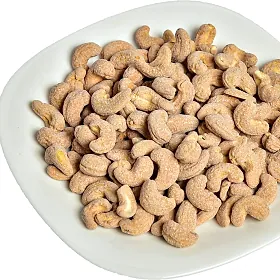
SW deserves specific mention. Scorching is cosmetic discolouration from processing heat, not spoilage. Under a roast and a seasoning coat, it disappears entirely — which makes SW a serious option for seasoned snack lines operating on tight margins.
The distinction between LWP, LP and SP is fragment size, and it matters more than buyers expect. A visible inclusion in ice cream or a cookie needs LWP or LP to read as "cashew" on the palate. A paste or spread can use SP with no perceptible difference, because grinding erases fragment size entirely.
What quality parameters come with a grade?
The grade code sets size; a separate quality standard sets acceptable defects. Full AFI 2016 specification calls for moisture below 5%, foreign material below 0.1%, defective kernels below 4%, no live insects and no rancidity. Middle East premium specifications commonly tighten moisture to 4.5% for tin packing.
Three quality tiers appear repeatedly in Vietnam cashew contracts:
AFI 2016 full — the strictest common specification, appropriate for premium retail in the US, EU and Japan. Moisture under 5%, foreign material under 0.1%, defective kernels under 4%.
Middle East premium — AFI-based with moisture tightened to around 4.5%, reflecting the longer and more humid transit and storage chain and the region's preference for tin packing.
China 2 — more lenient on defect tolerance, reflecting a market that prices differently and often processes further after import.
Naming the tier in your enquiry does more work than describing quality in adjectives. "Export quality" means nothing enforceable; "AFI 2016 full specification, moisture max 5%, defective kernels max 4%" means something a laboratory can test and a contract can reference.
Note that blemished and broken grades carry their own tolerance sets — the DW class allows total defects up to 14% by definition. A DW lot testing at 12% defects is compliant, not defective. Buyers who apply a white-grade tolerance to a blemished-grade contract create disputes out of nothing.
What the grade code does not tell you
A grade code carries size and, by convention, a class. It carries nothing about origin, crop year, processing method or how long the kernels have been in storage. Two lots correctly labelled W320 can differ substantially on all four, and each of those differences reaches the consumer.
Four things worth writing into the enquiry because the grade code will never supply them:
Crop year. Cashew is an agricultural product with a harvest cycle. A current-crop lot and a lot carried over from the previous season can both meet specification while differing in freshness. Ask which crop the offer relates to.
Time since processing. Kernels begin their shelf life at shelling, not at shipment. A lot processed months ago inside a sealed vacuum bag may be entirely sound, but you should know rather than assume.
Processing method. Steam and drum roasting produce different kernel characteristics, and the choice affects both appearance and how the kernel behaves in your downstream process. Where it matters to your product, specify it.
Origin of the raw nut. Vietnam processes raw cashew nuts from multiple origins alongside domestic crop. This is normal industry practice rather than a problem, but if your marketing makes an origin claim, the claim needs to survive scrutiny — and that requires asking before you write it on a pack.
None of these are difficult questions, and a competent supplier answers all four without hesitation. They belong in the same enquiry as the grade, because discovering them after arrival converts a routine sourcing decision into a labelling problem.
Why can't I order only W180?
Because grade distribution is an output of the raw nut and the shelling process, not a production choice. A factory shelling a lot of raw cashews produces a spread of sizes, whole kernels and breakage simultaneously. Large premium grades are the scarcest fraction of that spread, which is what makes them expensive.
This is worth internalising because it explains supplier behaviour that otherwise looks obstructive.
When a supplier says W160 has limited availability, they are usually describing physical reality rather than negotiating. Large kernels require large raw nuts, which depend on crop and origin, and then require selective processing to separate. No amount of ordering pressure creates them.
It also explains why breakage grades exist in volume and always will. Shelling a hard shell off a curved kernel produces splits and pieces as an unavoidable by-product. Those grades are not a quality failure being disposed of; they are a structural output looking for the applications that suit them.
The practical consequence for a buyer: a supplier who can absorb your whole-grade demand and place the associated breakage elsewhere will quote you better than one who cannot. If your product can take both a whole grade and a pieces grade, saying so in the enquiry often improves the whole-grade price.
Which grade should I choose for my product?
Match grade to what the consumer actually sees. If the kernel is visible and whole at point of sale, buy on size: W160 to W240. If it is visible but incidental, W320 to W450. If it is ground, baked, coated or blended, buy blemished or broken grades and put the saving into the product.
| Your product | Grade to start from |
|---|---|
| Premium gift box, festive pack | W160 / W180 |
| Premium jar, transparent pack | W180 / W210 |
| Mainstream retail roasted snack | W240 / W320 |
| Bulk industrial snack | W320 + SW |
| Coated or seasoned snack | SW / DW320 |
| Bakery inclusion, cookies, cereal | W450 / BB |
| Chocolate-coated cashew | DW320 / DW360 |
| Nut butter, spread, praline | LP / SP |
| Cashew milk | DW360 / SP |
| Trail mix, muesli | W450 + WS |
| Ice cream inclusion | LWP / LP |
Start from this table, then adjust for one variable: how much of the kernel survives to the shelf intact and visible. That single question resolves most grade decisions faster than a price list does.
When does grade substitution work?
Substitution works whenever the downstream process removes the difference. W240 to W320 is safe for most non-transparent packaging. White to blemished is safe for any coated or ground application, saving 10–25%. W160 and W180 cannot be substituted when the pack is transparent and size is the product's selling proposition.
Four rules we apply when a buyer asks whether they can step down:
Transparent pack, size-led positioning — do not substitute. The grade is doing marketing work that a cheaper grade cannot do. This is the one case where the premium is genuinely earning its cost.
Opaque pack, whole kernel required — one size step down is usually invisible. W240 to W320 changes the count per pack, not the consumer's perception. Check your fill weight and pack count arithmetic, and the change is otherwise silent.
Colour concealed by processing — switch class, not just size. This is the substitution most buyers miss. Instead of moving W240 to W320 for a single-digit saving, move WW to DW for 15–22% on the same size. If the kernel ends up under chocolate, seasoning or in a grinder, the colour premium is pure waste.
Kernel integrity destroyed in processing — go straight to pieces. Skip the intermediate steps entirely. The correct comparison is not W320 against W450 but W320 against LP.
Choosing the grade is a product economics decision that happens before any price negotiation, and it moves cost further than negotiation usually can. HotaNuts works with buyers on exactly this step — as a Vietnam-based sourcing and export partner, matching grade and class to end use before a single quote is requested.
Glossary
AFI — Association of Food Industries, whose cashew standard defines kernel grade codes and defect tolerances used in international trade.
BB — Baby Bits, the smallest broken kernel fragments, used as bakery and cereal filler.
BW / DW — Blemished Wholes, whole kernels with colour variation or surface marks; coded BW under AFI and traded as DW in Vietnam.
LP — Large Pieces, broken kernel fragments suited to nut butter and inclusions.
SK — Spotted Kernels, whole kernels carrying coloured spots from pre-harvest pest attack.
SW — Scorched Wholes, whole kernels darkened by processing heat, cosmetically affected but intact.
W240 — Whole white cashew kernel grade with 220–240 kernels per pound under the AFI standard.
WS — White Splits, kernels separated along the natural seam into two halves.
Frequently Asked Questions
What is the difference between W240 and W320 cashews?
W240 contains 220–240 kernels per pound and W320 contains 300–320, so W240 kernels are visibly larger and priced higher. Both grades share the same quality parameters; the code describes size only, not eating quality or defect level.
Is W180 better quality than W450?
No. Both codes describe kernel count per pound, not quality. W180 kernels are larger and cost more, while W450 kernels are smaller and cheaper. Quality is set separately by moisture, broken and defect tolerances that apply across all grades.
What does DW mean in cashew grading?
DW stands for the Blemished Wholes class, coded BW under the AFI standard. These are whole kernels with colour variation or surface marks, typically priced 15–25% below equivalent white grades while retaining full size and crunch.
Are spotted cashew kernels safe to eat?
Yes. Spotting on SL and SK grades comes from pest attack on the kernel before harvest, not from contamination or processing failure. Kernel shape, texture and eating quality remain intact, which is why these grades serve confectionery and industrial applications.
Which cashew grade is cheapest for nut butter?
Small pieces and baby bits are the most cost-effective for nut butter because grinding destroys any visual difference between whole and broken kernels. LP and SP deliver identical finished product quality at a substantial saving over whole grades.
Do W320 and WW320 mean the same thing?
Yes. W stands for White and WW for White Whole, and both refer to the same grade of 300–320 kernels per pound. The notation varies by supplier and carries no difference in specification, price basis or quality.
What cashew grade should I use for a transparent retail jar?
Choose W160 to W240, because a transparent pack sells on visible kernel size. Substituting a smaller grade in transparent packaging changes the shelf impression directly and usually costs more in lost conversion than the grade saving returns.
Why is W160 harder to source than W320?
Grade distribution is an output of the raw nut and shelling process rather than a production choice. Large kernels require large raw nuts and selective processing, making them the scarcest fraction of any lot regardless of order volume or price offered.
Take the next step
Grade is the first of four decisions that set your landed cost. Article 3 covers the RFQ that gets you comparable quotes once you know your grade and class, and Article 4 explains packing and container loading — where the same grade varies in delivered cost depending on how it is boxed.
If you want a second opinion on grade selection for a specific product, our team is happy to look at your spec and end use.
Last updated: 2026-09-22. Grade definitions follow the AFI cashew standard; count ranges and class tolerances from the HotaNuts product specification.