




Why Salmonella is critical for cashews
- Cashews are eaten raw (or lightly roasted) — unlike meat (cooked ≥75°C which kills pathogens)
- Survives dry environments — Salmonella persists for months in dry cashew kernel
- Low infectious dose — as few as 10–1,000 CFU can cause infection (very low threshold)
- Public health risk: causes diarrhea, fever, dehydration; particularly dangerous for children, elderly, and the immunocompromised
Major recall history (US + EU)
- 2012 — Sunland Inc: largest US peanut/nut recall; Salmonella Bredeney; >250 reported illnesses
- 2014 — Trader Joe's Tiny Triangle Organic Cashews: multi-state recall
- 2015-2020 — multiple Costco/BJ's recalls covering cashew + nut mixes
- Pattern: most driven by post-roast contamination (not raw) or kill-step validation failure
Biology in brief
Salmonella has over 2,500 serotypes. Those documented in cashew recalls include:
- Salmonella Typhimurium
- Salmonella Bredeney
- Salmonella Enteritidis
- Salmonella Newport
Source: contamination from raw material (bird/rodent waste on farms), equipment cross-contamination, or post-processing handling.
FDA "kill step" requirement
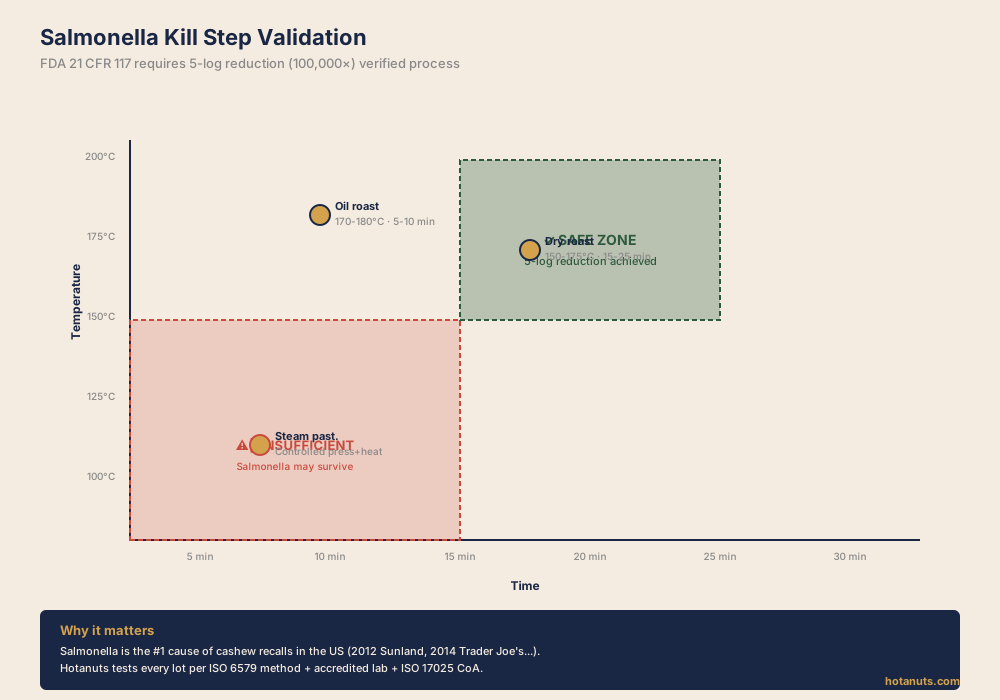
Per FDA 21 CFR 117 (FSMA Preventive Controls), every ready-to-eat cashew must have a validated kill step — verified to achieve at least 5-log reduction (100,000×) of Salmonella.
Common kill-step methods:
- Steam pasteurization: controlled pressure + temperature (common for raw cashew processors)
- Dry roasting: 150-175°C for 15-25 minutes — validated
- Oil roasting: 170-180°C for 5-10 minutes
- PPO (Propylene Oxide) fumigation: used in some US facilities; uncommon in Asia because EU does not permit it
Hotanuts QC process for Salmonella
Inbound (raw cashew arrival)
- ☐ Environmental swab test at incoming storage (container floor, pallets)
- ☐ Random 250 g sample per lot for preliminary Salmonella test (qPCR method)
- ☐ Log lot with traceability code
Processing (partner factory)
- ☐ Validated kill step documented — temperature + time log
- ☐ Equipment sanitation schedule: daily hot-water rinse, weekly deep clean
- ☐ Zone separation: raw zone ≠ ready-to-eat zone (physical barrier, separate PPE)
- ☐ Airflow: positive pressure in the RTE zone
Outbound (pre-shipping)
- ☐ Lot-level Salmonella test — ISO 6579 method, accredited lab
- ☐ Certificate of Analysis attached (standard: n/c = negative per 25 g sample, 5 samples per lot)
- ☐ Time-temperature log during shipping (if buyer requires refrigerated transport)
Buyer ask-checklist — 6 questions for ANY Vietnamese supplier
You (the buyer) should ask every supplier these six questions:
- ☐ Q1: What is your validated kill step? (request a copy of the validation study)
- ☐ Q2: What test method do you use? (ISO 6579 is the standard — enriched PCR is also acceptable)
- ☐ Q3: Test frequency? (per lot is the minimum; random-batch testing is a red flag)
- ☐ Q4: Name of accredited lab + ISO 17025 certificate?
- ☐ Q5: Post-roast Salmonella testing (not only raw)?
- ☐ Q6: Environmental monitoring programme (EMP)?
If the supplier cannot answer all six → change supplier.
What happens if a lot tests positive
Rare, but if Salmonella is detected:
- Hold the lot — do not ship
- Investigate the source: raw material, equipment, personnel
- Corrective action: re-sanitize, re-validate the kill step
- Re-test after the corrective action
- Dispose if remediation is not possible; re-process (additional kill step) if feasible
- Document in the CAPA (Corrective and Preventive Action) log
Hotanuts has never had a positive-Salmonella shipment — but we maintain a CAPA protocol ready to deploy.