
















July 2026 brief · 8 min read · By Tung Tran, Sourcing & Export Sales
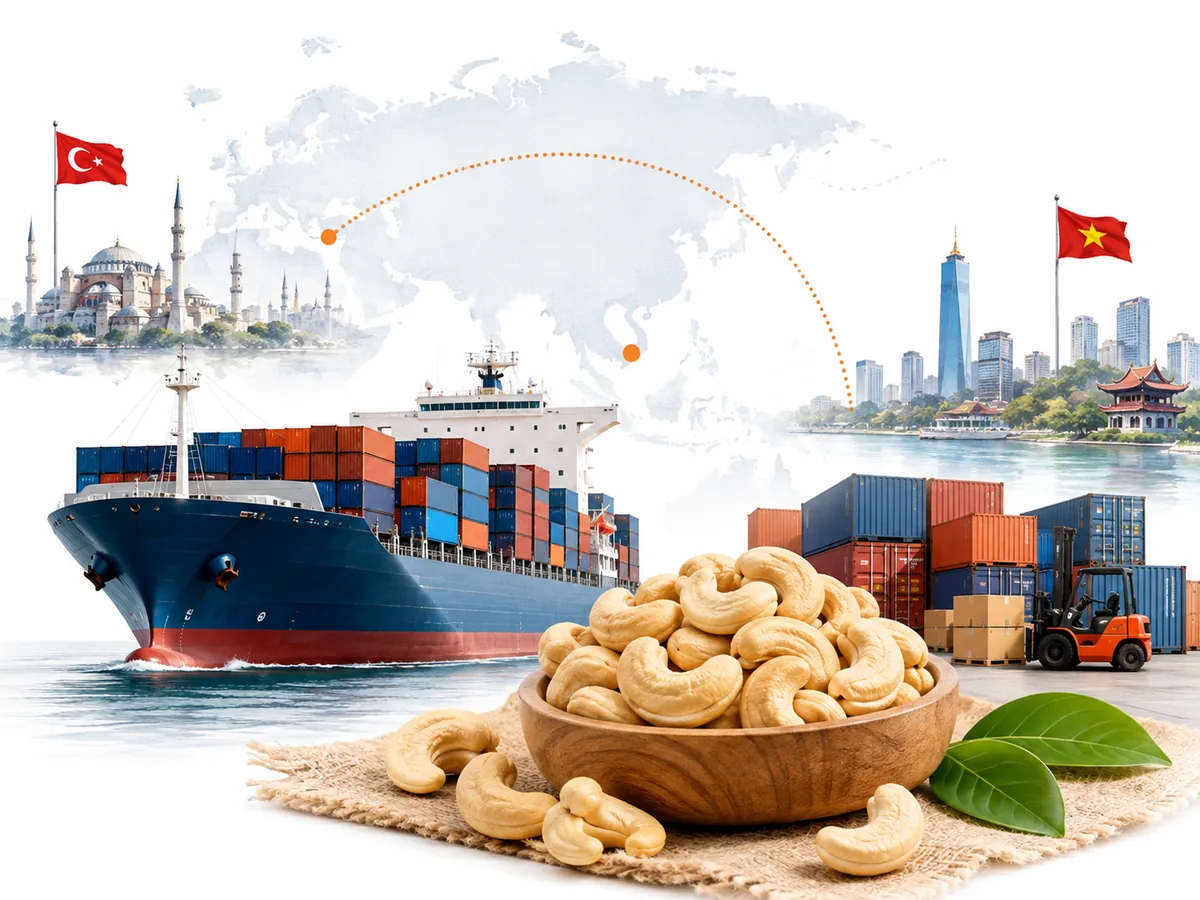
July 2026 was a good month for Vietnamese cashew kernel going to Turkey. Volume reached 3,822.8 tonnes, value USD 30.60 million, and the average unit price about USD 8,004 per tonne. Against July 2025, volume rose 17.1% and value rose 25.1%.
Read July on its own, though, and you will come away too optimistic. Across the first seven months, Vietnam has shipped Turkey 18,597 tonnes worth roughly USD 141.6 million — still behind the same period last year, at a time when Vietnamese cashew exports overall are growing.
So the question worth asking is not whether Turkey is up or down. It is that this market has changed what it buys.
Contents
- A strong month after a weak start to the year
- July was strong, but the year to date still trails 2025
- Turkey is buying a different kernel than before
- W320 fell hard across the year, but July brought it back
- Why is the average unit price to Turkey so high?
- This is a market built for W180 and W240
- Turkey is now the second-largest Middle East market
- What the sales desk should watch
- Conclusion
A strong month after a weak start to the year
July volume reached 3,822.8 tonnes — fourth highest of the 31 months tracked, and about 16.7% above the median of the last twelve. But the more telling number is the rhythm of buying, which changed outright in the second quarter.
Through the first three months, shipments to Turkey averaged only about 1,343 tonnes a month. March was the floor at roughly 1,056 tonnes.
From April onward the baseline jumped to about 3,642 tonnes a month — 2.7 times the level of the opening quarter. May came close to 3,964 tonnes.
Measured by buying activity, 2026 splits cleanly in two:
| Period | Average monthly volume | Character |
|---|---|---|
| January–March | ~1,343 t/month | Weak market, thin order flow |
| April–July | ~3,642 t/month | Buying resumed at a distinctly higher level |
July alone was 17.1% above the same month last year. Current trading has recovered substantially from where the year began.
July was strong, but the year to date still trails 2025
Seven-month cumulative volume stands at 18,597 tonnes against roughly 19,923 tonnes for the same stretch of 2025. Turkey's share of total Vietnamese cashew kernel exports therefore slipped from 5.11% to 4.18%. But that shortfall is not spread across the year — almost all of it sits in two months.
Pull the lens back a year and the shape is clearer:
| First seven months | Volume to Turkey | Share of Vietnamese exports |
|---|---|---|
| 2024 | 13,745 t | 3.36% |
| 2025 | 19,923 t | 5.11% |
| 2026 | 18,597 t | 4.18% |
Turkey took a very large step up in 2025. Share has come back in 2026, but it remains well above 2024. In other words: this market is off the 2025 peak, yet still standing above its own longer-run baseline.
What matters is where the shortfall sits. Almost the entire gap against last year comes from January and March — those two months alone account for roughly 99% of it. April and July were both ahead of their year-earlier counterparts.
For a sales desk that distinction is the whole point: the cumulative figure is still negative because of a hole dug at the start of the year, not because current demand is still weakening.
Turkey is buying a different kernel than before
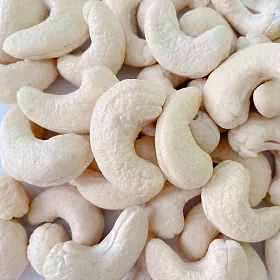
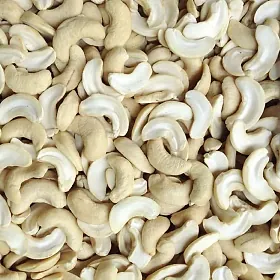
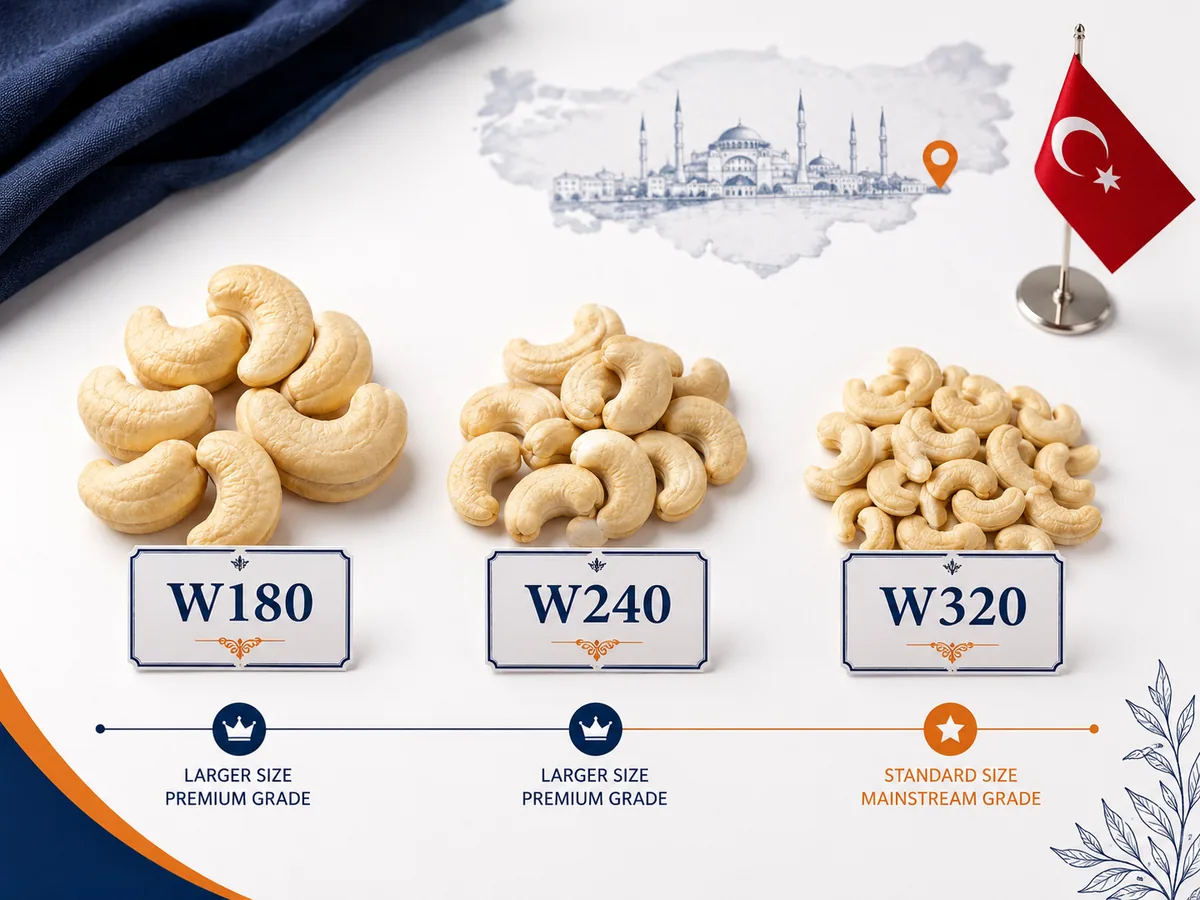
The important change is not in total volume but in grade mix. W320 has lost nearly half its volume and about 15.7 percentage points of share, while W240 has moved into first place. This market is leaning hard toward large whole kernels.
Cumulative, first seven months of 2026:
| Grade | Volume | Year on year | Share |
|---|---|---|---|
| W240 | 6,651 t | +17.9% | 35.8% |
| W180 | 4,427 t | −0.2% | 23.8% |
| W320 | 3,813 t | −47.2% | 20.5% |
| W, size unstated | 1,323 t | +57.6% | 7.1% |
| WA180 | 299 t | +130.6% | 1.6% |
W240, W180 and W320 together account for roughly 80% of what enters this market.
Commercially this matters a great deal. Most destinations build their volume on W320. Turkey no longer does.
W320 fell hard across the year, but July brought it back
July did not follow the cumulative trend. In that month alone W320 reached roughly 928.6 tonnes, up 107.2% on June. Over the same month W180 rose about 14.9% while W240 fell about 17.0%.
After a very deep slide through the first half, W320 has shown signs of recovering on volume.
One month is not a trend. But it is the thing a sales desk should be watching: if W320 keeps climbing through August and September, Turkey's buying mix may be rebalancing.
For anyone quoting into this market, it also means resisting the shorthand that Turkey "only wants W180 and W240". The current mix leans that way, but W320 demand can return quickly.
Why is the average unit price to Turkey so high?
July's average unit price to Turkey was about USD 8,004 per tonne against a national average of roughly USD 7,113 — a gap of about 12.5%. The easy conclusion is that Turkish buyers pay more. The real reason is what sits in their basket.
Across the volume where grade could be identified, July looked like this:
| Grade | Turkey | National |
|---|---|---|
| W180 | 27.4% | 10.2% |
| W240 | 36.8% | 25.8% |
| W320 | 27.6% | 45.6% |
Turkey takes W180 at nearly three times the national share, and W320 at well below it.
Since W180 and W240 are structurally dearer than W320, that mix difference alone is enough to lift the whole market's average price. Most of the 12.5% gap comes from there — not from buyers accepting a higher number for the same product.
That distinction changes how you should approach the market:
Turkey is attractive not because buyers pay a premium, but because the market absorbs a large share of the higher-value grades.
This is a market built for W180 and W240
Look at revenue rather than tonnage and the commercial value of this market becomes obvious. In July volume rose 17.1% year on year while value rose 25.1%. That gap is the grade mix doing the work.
W180 and W240 both carry more value per tonne than W320. When their share rises, revenue outruns volume.
For a kernel seller, this is a market worth pursuing when you have large-kernel supply in hand. It also helps balance your product mix rather than concentrating everything on W320.
Turkey is now the second-largest Middle East market
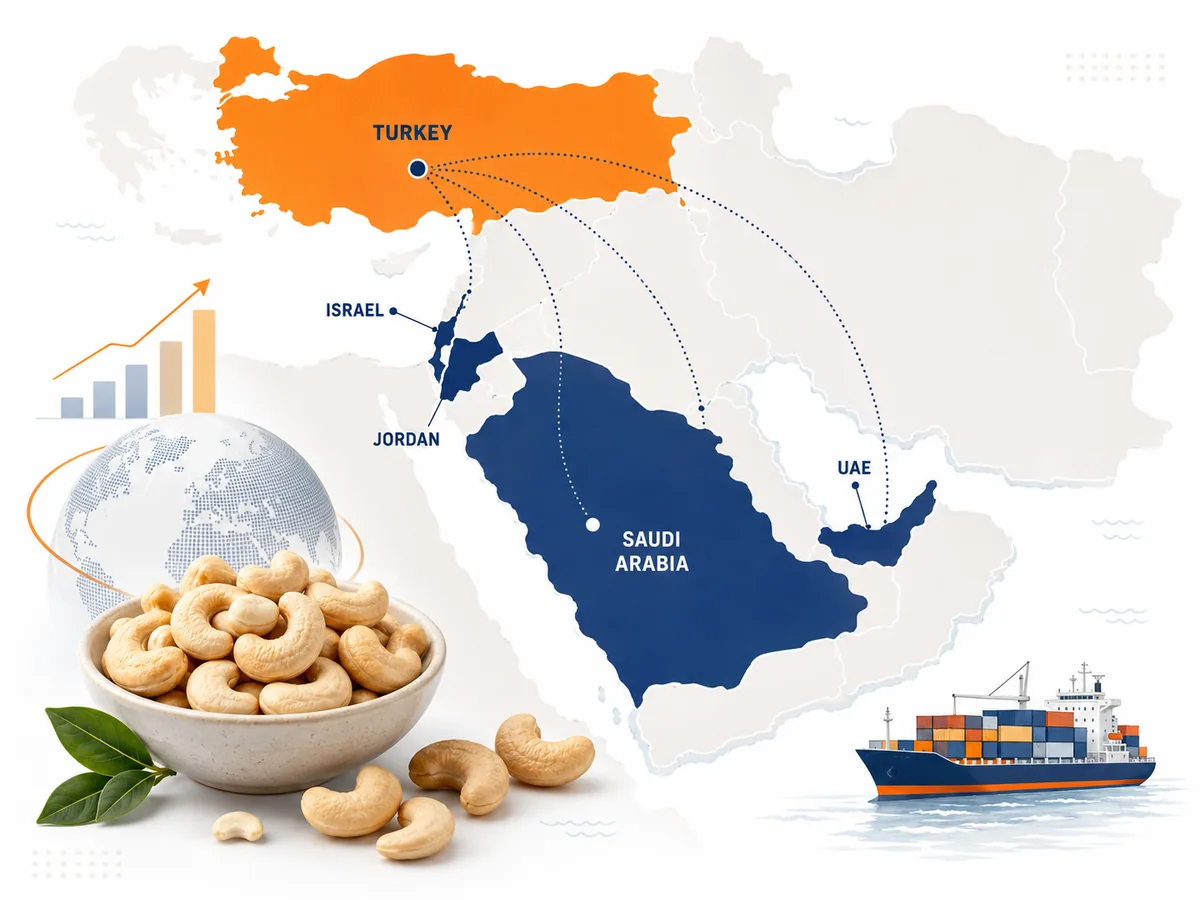
In July 2026 Vietnam shipped roughly 12,619 tonnes of cashew kernel to the Middle East. Turkey ranked second among the region's 16 markets, behind only the UAE. Those two together took about 66.6% of everything entering the region.
| Rank | Market | July volume | Regional share |
|---|---|---|---|
| 1 | UAE | 4,580.2 t | 36.3% |
| 2 | Turkey | 3,822.8 t | 30.3% |
| 3 | Saudi Arabia | 1,056.7 t | 8.4% |
| 4 | Israel | 983.2 t | 7.8% |
| 5 | Jordan | 841.0 t | 6.7% |
Turkey is not a secondary market in this region. It is one of the two main gateways for Vietnamese cashew kernel into the Middle East.
Across all regions, the Middle East was also among the strongest performers in July.
One caution when reading the table: the UAE is a major transshipment point, so volume declared there does not necessarily stop there. Turkey is different — it is both a consuming market in its own right and a gateway to the countries around it.
What the sales desk should watch
Strip out the technical detail and four things matter commercially: demand recovered from the second quarter, W240 is now the most important grade, W180 is the high-value segment to prioritise, and W320 needs watching again.
Demand recovered from Q2. The April–July baseline runs several times above the first quarter. The market today is materially stronger than it was in January.
W240 is the most important grade. Seven-month volume of 6,651 tonnes, up 17.9% year on year.
W180 is the high-value segment. Turkey's W180 share runs far above the national export mix — this is genuine demand for large kernel, not incidental volume.
W320 needs watching again. Cumulative volume is still down sharply, but July more than doubled on June.
And the next question for a sales desk should not stop at "what is the market price". It should be: which grade is the customer actually buying, which grade is gaining volume, and is the shift from W320 into W240 and W180 a real structural move or short-term noise. That is the data that feeds an offer.
Conclusion
July 2026 reads positively: volume and value both well up year on year, buying rhythm clearly recovered since the second quarter, and Turkey holding second place in the Middle East. But the headline growth is not the story.
Turkey's buying mix has tilted decisively toward W240 and W180.
That is why export value per tonne runs above the national average, and it is why this market is worth particular attention from suppliers who can put large kernel on the table.
W320 remains the open variable. After falling sharply across the year, buying rebounded clearly in July. If that holds for another month or two, the market may be moving toward a more even balance across the three grades.
For an exporter, then, Turkey is best understood as a market of real scale that consumes high-value grades, rather than simply a market that pays well.
What to watch over the coming months: volume by individual grade — W240, W180 and W320 above all — and whether the elevated buying rhythm of the second quarter carries through to the end of the year.
Data covers July 2026, compiled 30 August 2026. Analysis is based on cashew kernel export data under HS 08013200, cross-checked against the industry series. No exporter-level, customer-level or shipment-level information is used.
Need a quote for a specific order?
Send us the grade, volume, destination port and target shipment window. We come back on stated delivery terms with the specification written out, so you can compare it directly against any other supplier: Contact us