






Africa Processes More of Its Own Cashews: A Second Kernel Source Comes First
Last updated: 05/10/2026 · 3 min read · By Tùng Trần, Sales Executive
Our view: Africa processing more of its own cashews will not leave Vietnamese kernels in short supply over the next few years. What arrives first is a second kernel source, almost entirely from Côte d'Ivoire, competing in the standard grades.
Three reasons:
- Local processing is growing in essentially one country.
- The other countries do not yet have enough plants, so they are choosing multi-year roadmaps over raw nut export bans.
- Ivorian kernels have found a place in Europe, but in the standard grades, not yet in the large sizes.
1. Local processing is growing in essentially one country
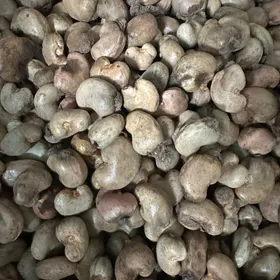
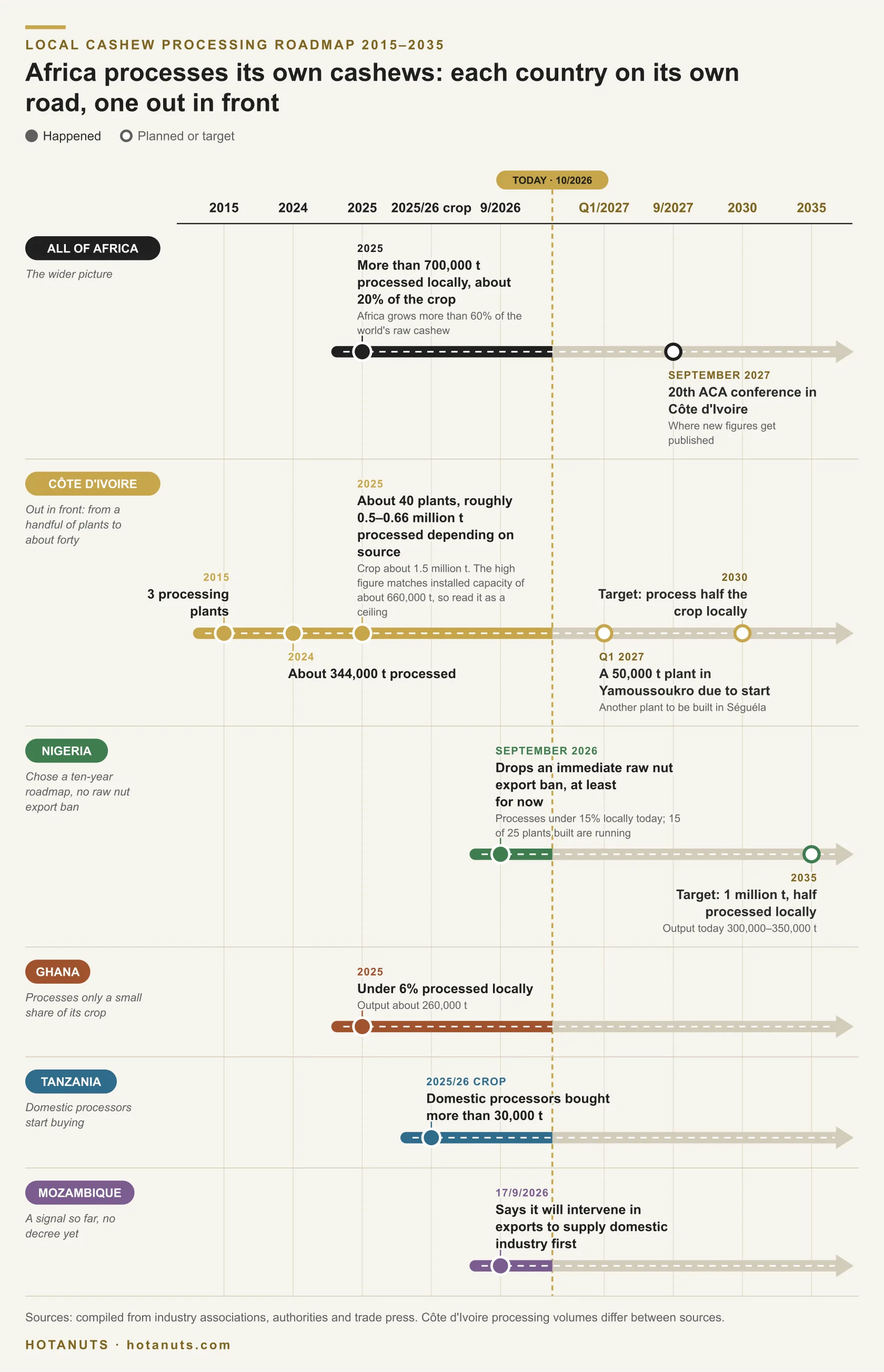
Africa as a whole processes only about a fifth of the raw cashew it grows, and most of that happens in Côte d'Ivoire. Ten years ago the country had a handful of plants; it now has about forty, with a target of processing half its crop locally by 2030.
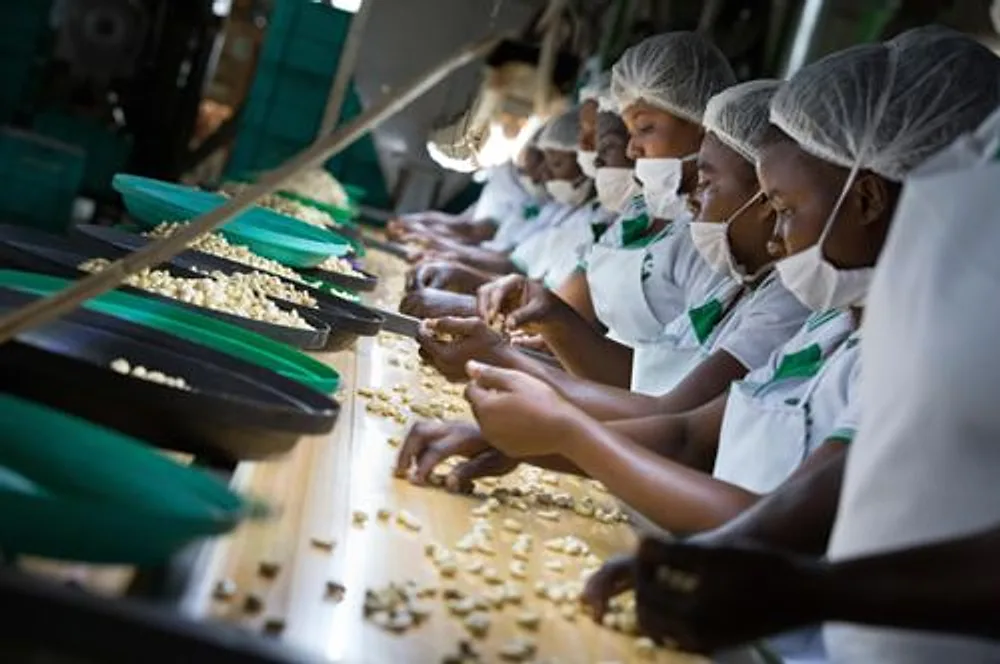
The other producers process only a small share. Nigeria and Ghana process a small part of their crops; Tanzanian processors bought more than 30,000 tonnes last season.
The upshot: when buyers talk about "Africa processing its own cashews", they are really talking about Côte d'Ivoire. Sources still disagree on how much the country processes; the highest figure matches the installed capacity we noted in our contrarian look at the 2030 target, so it is best read as a ceiling.
2. The other countries choose roadmaps, not export bans
Banning raw nut exports before local plants can absorb the crop only leaves the nuts with farmers and pushes farm-gate prices down. That is why the large producers are moving slowly.
In September, Nigeria set aside an immediate raw nut export ban, "at least for now", in favour of a ten-year roadmap to 2035; only just over half of the plants it has built are running. Mozambique says it will intervene in exports to supply its own industry first, but has not issued a decree.
What this means for Vietnamese processors: African raw cashew supply will tighten gradually, in step with plants there, rather than stop overnight. A sudden cut would come from an export ban, not from new plants.
3. Ivorian kernels compete in the standard grades
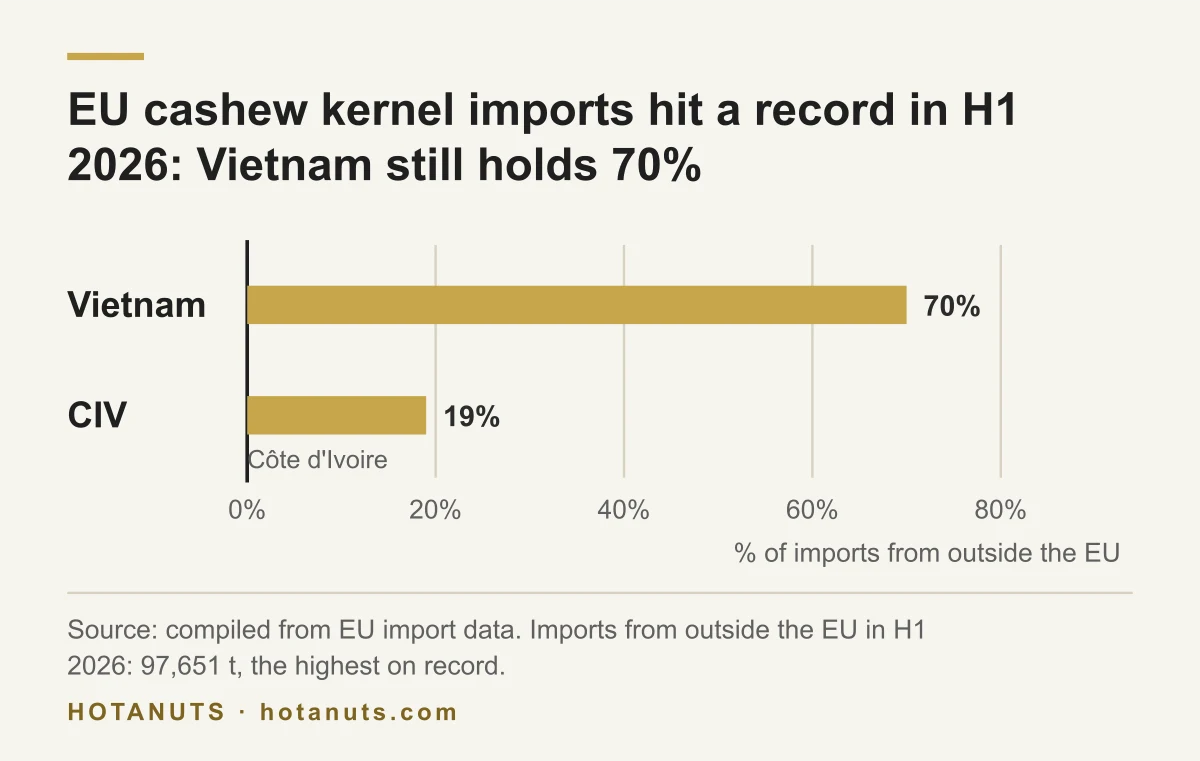
The EU imported more cashew kernels in the first half of this year than ever before. Vietnam still holds most of that, with Côte d'Ivoire in second place. Both things are true: the second source has found a place, and Vietnamese kernels have not had to give ground.
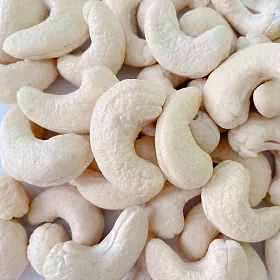
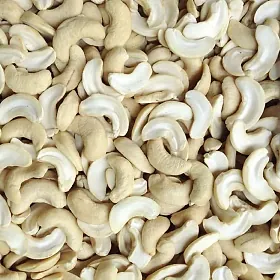
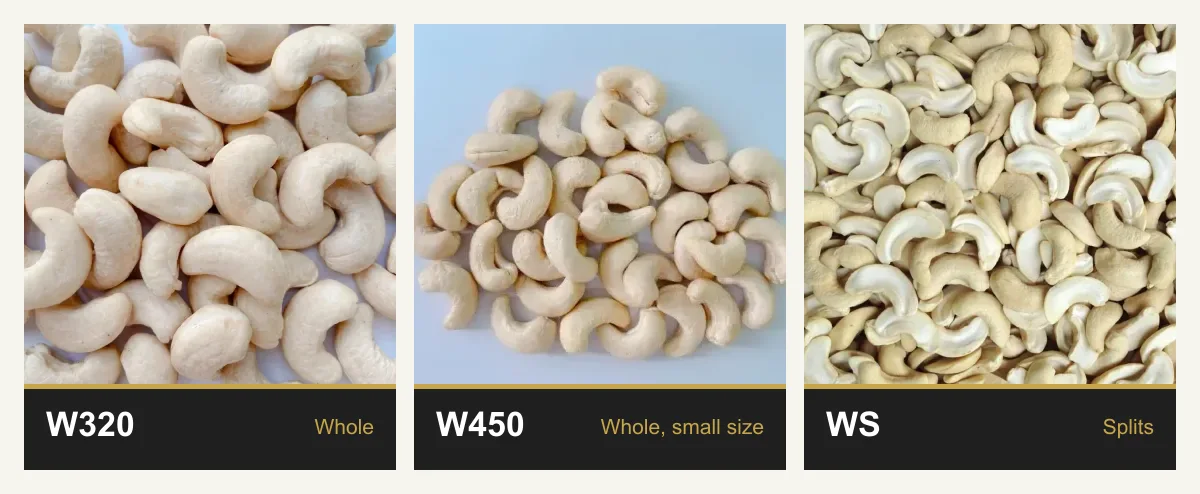
Ivorian kernels are catching up first in the standard grades such as W320, W450 and splits. Large sizes for premium retail still come mainly from Vietnam.
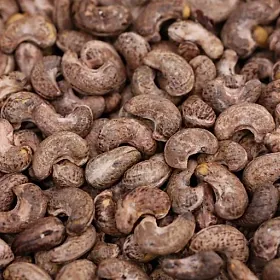
We work both sides: we offer African raw cashew to Vietnamese processors and kernels to buyers. From that position, pressure from Africa keeping its raw nuts shows up first in raw cashew prices and processor margins, and last in kernel offers.
What to watch
- A raw nut export restriction. If Mozambique issues a decree or Nigeria returns to an export ban, raw cashew supply for Vietnamese processors tightens within the season.
- The new plant in Yamoussoukro. If it starts on time in Q1 2027, the second kernel source grows and the share of Ivorian raw cashew sold to Vietnam shrinks.
- The ACA conference in Côte d'Ivoire, September 2027. This is where countries publish new processing figures; whether local processing moves towards the ceiling will show whether the roadmaps are real.
For buyers
- Roasters in Europe: compare Ivorian offers with Vietnamese kernels on the same grade, packing and delivery terms, and ask the seller how many months of the year they can ship steadily.
- Packers in the Gulf: much Ivorian kernel already goes to the Middle East in the standard grades; the source is worth considering for large sizes once it can ship steadily all year.
Send us the Ivorian offer you have in hand and we will set it next to a Vietnamese offer for the same grade.
Compiled from public information by industry associations, authorities and trade press; updated 05/10/2026. Processing volumes in Africa differ between sources and should be read as approximate.