



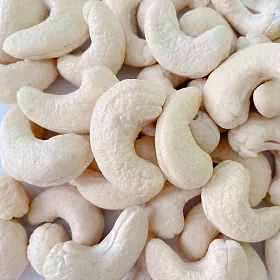
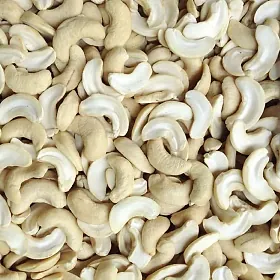
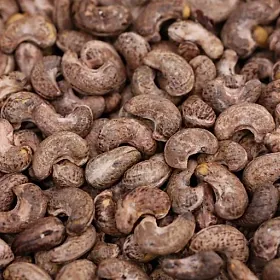
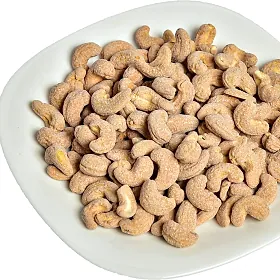
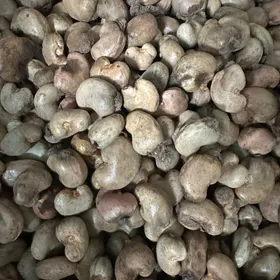









Before a cashew lot leaves our processing partner facility, it passes six tests. Three are routine and quick. Three are slower and only triggered when the first three flag something. None of them are negotiable for buyers placing on the EU market.
This is the walkthrough.
Test 1 — Moisture
Kernel moisture is the upstream control for almost every downstream food safety question. Target moisture is below 5% at lot release, measured per the ISO 6673 method or equivalent gravimetric procedure. Below 5% suppresses fungal growth, locks in shelf life, and stabilises the kernel for sea freight.
Sampling at lot release captures the post-drying state. A separate sampling point earlier in the line captures the immediate post-cracking state. Both need to land in spec.
Test 2 — Defect and breakage
Defect and breakage is graded against the AFI specification or equivalent buyer-defined spec. Codex STAN 131 sets the overall food category framework; AFI 2016 sets the cashew-specific operational tolerances most buyers reference today.
The breakage tolerance varies by grade. W320 typically expects breakage below 3%; W180 has tighter expectations because the kernel size premium depends on visual integrity. Defect categorisation (Grade 1 spotted, Grade 2 dark, immature kernels) has its own thresholds within the same specification.
Test 3 — Foreign matter
Foreign matter target is zero. Detection is layered:
- Visual sort by trained line operators
- Metal detector at the packing stage, verified daily against a test piece
- X-ray scanning for non-metal foreign matter (stone fragments, hard plastic)
Daily test piece verification of the metal detector is itself a BRC v9 documented control. A buyer who wants to verify this layer can request the test piece verification log directly.
Test 4 — Aflatoxin
Aflatoxin testing follows EU Regulation 2023/915 limits: aflatoxin B1 below 2 μg/kg and total aflatoxins below 4 μg/kg for nuts intended for direct human consumption. Slightly higher tolerances apply for nuts intended for further processing.
The screening method at lot release is ELISA — a rapid quantitative immunoassay that returns results in roughly one hour. Any lot showing elevated screening result triggers HPLC confirmation, a chromatographic gold-standard method that takes longer but provides definitive quantification.
Per-lot composite sampling follows the methodology in Codex STAN 131. Sample size and distribution across the lot are documented and reproducible. Buyers requesting independent verification can have Pre-Shipment Inspection (PSI) through SGS, Intertek, or Bureau Veritas using sample selection from the same production lot.
Test 5 — Microbiological panel
For cashew kernels intended for ready-to-eat consumption, the microbiological panel typically covers:
- Total Plate Count (TPC) below 10⁵ CFU/g per ISO 4833 method
- E. coli, Salmonella, Listeria absence in specified sample size
- Yeast and mould count per product specification
Microbiological testing typically takes 48-72 hours for plate-count incubation and longer for selective enrichment if pathogen presence is questioned.
Test 6 — Pesticide residue
Pesticide residue testing covers the EU MRL panel under Regulation 396/2005 for placement on the EU market. The panel includes residues from compounds the cashew supply chain may have been exposed to upstream (raw cashew nut production, post-harvest treatments).
For Japanese buyer requirements, the JAS Positive List adds additional analytes. For Gulf Cooperation Council buyers, the relevant national MRL frameworks apply.
Pesticide testing turnaround typically runs 5-7 business days through accredited labs.
How the six tests interlock
The first three tests (moisture, defect/breakage, foreign matter) are fast enough to gate the line at lot release stage. A failure here halts the lot pending rework or downgrade.
The slower three (aflatoxin, microbiological, pesticide) typically need to clear before the lot can be released for shipment. ELISA screening of aflatoxin happens at lot release; microbiological incubation runs in parallel; pesticide residue runs at an accredited external lab.
Buyers placing on the EU market should expect documentation for all six tests in supplier records, retained per lot for the regulatory retention period.
Third-party verification on buyer request
For first-time supplier engagements, or for lots above a contract-defined volume threshold, buyers commonly add an additional layer: independent third-party Pre-Shipment Inspection through SGS, Intertek, or Bureau Veritas. The sample is drawn from the same production lot, the inspection report is issued directly to the buyer, and the supplier sees the result simultaneously.
Suppliers that resist third-party PSI on first-time engagements are unusual. Suppliers that welcome it are signalling confidence in their own QC pipeline.
Where Hotanuts stands
Our processing partner facility documents all six tests per lot. We support third-party PSI on first-time engagements as a standard offering, not a negotiation point. Sample QC reports, anonymised on buyer-identifying fields, are available at the RFQ stage under NDA.
Request a sample QC report — anonymised real lot from a recent shipment.